
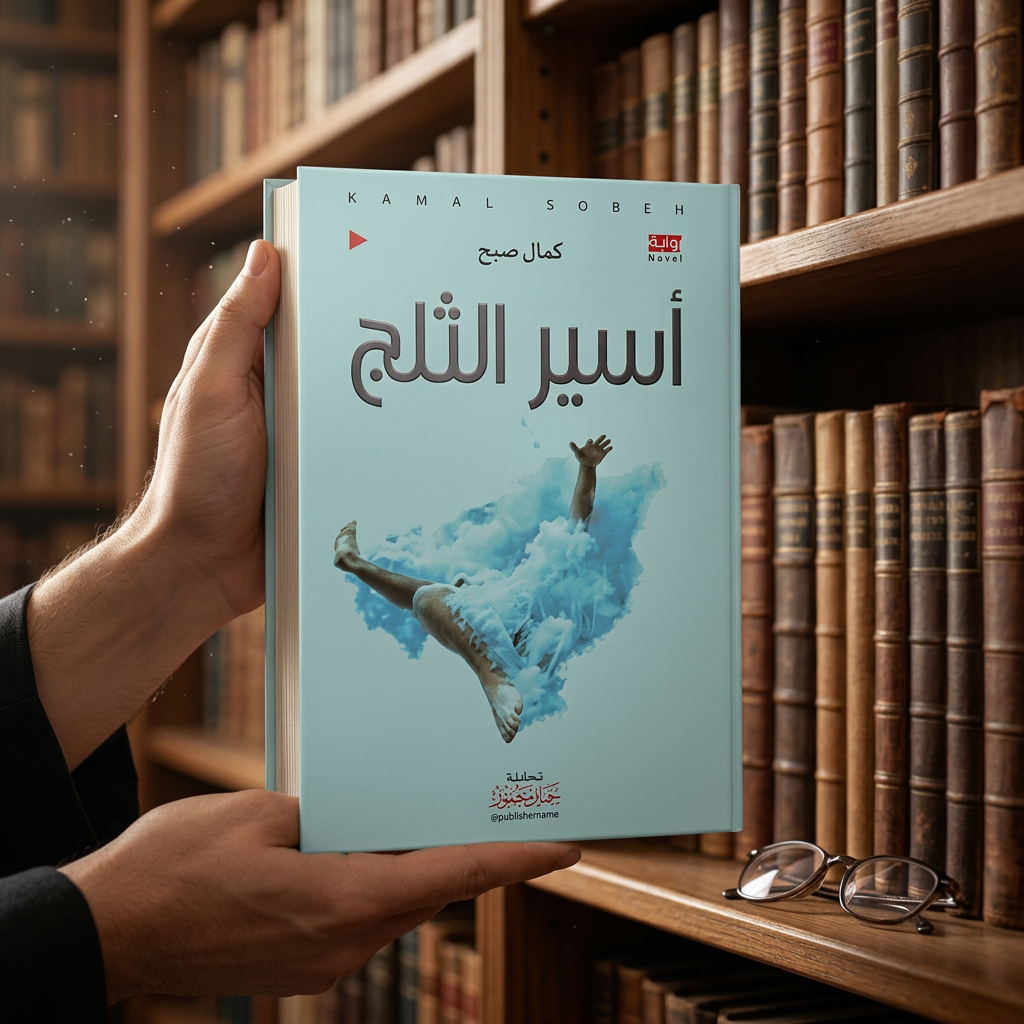
My Window Overlooks “Prisoner of the Snow”
Dr. Khaled Turki
“Prisoner of the Snow” is a novel by the Gazan writer Kamal Subh. It tells the story of a man from Jaffa who lived a nomadic life, moving between the captive city of Jaffa after its Nakba—”Many emigrated from Jaffa and scattered across the globe” (p. 181)—and the Norwegian city of Halden, moving between “the city of the sea and the sun” (p. 61) and the city of snow, cold, and frost, between lukewarm nerves and enthusiasm, zeal, and generosity, between a man who belongs to a land of heat and summer and a man who belongs to a land of snow and bitter cold. Youssef, the son of the novel’s protagonist, who was born in Norway, says, “I am torn between two nationalities. My Arab half is gloomy, painful, and dark, while my Norwegian half fears this vastness of the horizon. I am not afraid of the snowdrift, nor do I feel that it fell from the sky for me” (p. 61).
This is a novel narrated by its protagonist, Ibrahim, from Jaffa, through his diary entries, which he wrote on the pages of an old notebook. His son and daughter find it in a dilapidated and decaying wooden shack in his carpentry workshop in Halden, Norway. The workshop was located in the garden of the house where he lived with his wife, Jonas, their daughter, Reem, and their son, Youssef.
After his father’s death, Youssef finishes reading his father’s memoirs.
They also find some old coins from the Viking era in the box. “It’s truly a treasure,” (p. 28). The Vikings were seafaring peoples and the ancestors of the current inhabitants of Scandinavia.
Ibrahim Youssef Abdel Jalil Al-Sawaf and his daughter Reem fled from his first wife, Fatima, who had passed away, to Norway. He had left his second wife, Iman, seeking peace and tranquility after the wealthy widow had entrusted him with her company’s affairs. However, his Eastern heritage and Arab pride prevented him from continuing to work with her. He fled his reality after the Nakba of Jaffa. “We were under Israeli civil rule after its occupation of the major cities… Part of my family emigrated.” To the south and the few remaining, and I am one of their descendants… we hid until the war subsided and we stayed in our homes” (p. 107), “…Many emigrated from Jaffa, scattering to the far corners of the earth. Some were killed, others were lost. Legends were woven around the disappearance of all those who vanished…” (p. 181)…
Ibrahim and his daughter Reem emigrated via Lod Airport to Norway, only to find a reality even harsher than what he had experienced in his homeland. He was unable to adapt there, as his daughter Reem changed her name to Raymonda, shedding her Eastern identity and adopting a Norwegian one. She began her life as a Norwegian, forgetting the East, its customs, traditions, and her Muslim faith.
Reem got married and became Raymonda.
Upon his arrival, he began working to obtain Norwegian citizenship and a Norwegian passport to start his life and work. Granting a passport was contingent upon marriage to a Norwegian woman, so he married Jonas, whose name means “dove of peace.” They had a son, whom they named Joseph. Had it been a girl, her mother would have given her that name.
How Ibrahim wished that Joseph had been born in Jaffa, the land of the sea, palm trees, and oranges, rather than in a land of cold and snow.
“We will name him Joseph,” she replied. Her response was: “If it is a boy, we will name him whatever you wish, for no other reason than to please you.” (p. 141)
“Do you know, my son, why I named you Joseph against Jonas’s wishes? Joseph was thrown into a well by his brothers, and I have cast you into the snow.” Where there is no warmth for feelings or companionship, they sold him for a pittance, and I sold you with my helplessness and defeat before myself… I named you Joseph because I don’t want you to resemble me. Joseph the Prophet resembled no one; he resembled himself… He was beautiful, like an angel… I don’t want you for myself…” (p. 182)…
It happened that his daughter Reem returned—in this instance, his daughter Raymonda—at dawn after a night out. The smell of alcohol and smoke emanated from her. “…Hot blood rushed to my head; I felt fire burning in my eyes. When I asked her where she had been, she waved her hand in front of my face, as if swatting away a fly. I was about to hit her when I was startled by the voice of Jonas (his third Norwegian wife) from her bedroom window overlooking the garden: ‘Don’t you dare!'” “If you hit her, I’ll call the police. If you try to touch her, I’ll run away like a wounded cat. I was a coward and I ran away” (p. 165).
“She was my flower. I would water her with the water of my heart and eyes if she wished… I was his flower and his whole life” (p. 35). Reem felt, through reading the memoirs, that she had wronged her father. Ibrahim worked in Jaffa as a laborer in a restaurant, after he was widowed by his wife Fatima, and he took care of his daughter, Reem, in everything. One time he left his work to meet his daughter returning from school, which annoyed the restaurant owner, and he started shouting at Ibrahim, as panic and fear spread in his daughter Reem’s heart, as he called her a mangy cat, “…that is the first and last time you leave the restaurant for the sake of your mangy cat.” (p. 36) This behavior by the employer angered him, so he struck him until he bled. “I grabbed a stone lying by the roadside and hit him on the forehead with it, and hot blood gushed out, covering his face…” “I avenged my dignity… I avenged her fear of that bull…” (p. 37). When he returned home free after the people of the neighborhood vouched for him, he felt he had defended the workers, saying of the employer, “He is a nobody, a tyrant who brought humiliation upon himself by abusing and degrading the workers…” (p. 37).
After his release from prison, he found his daughter with his neighbor Iman, whom he later married. “I saw in her husband a reflection of myself. He was afflicted with illnesses and died, and the world has afflicted me, wanting me dead” (p. 49). Iman was a wonderful person: beautiful, charming, loyal, and pure-hearted. She was wealthy and powerful, and moreover, “…your care for my daughter Reem is enough for me.” (p. 70), “…Iman was a balm that healed my wounds…” (p. 108).
We live in an unforgiving Eastern society, rigid in its customs, traditions, and rigidity,
a society that represses itself to remain isolated and to maintain its power.