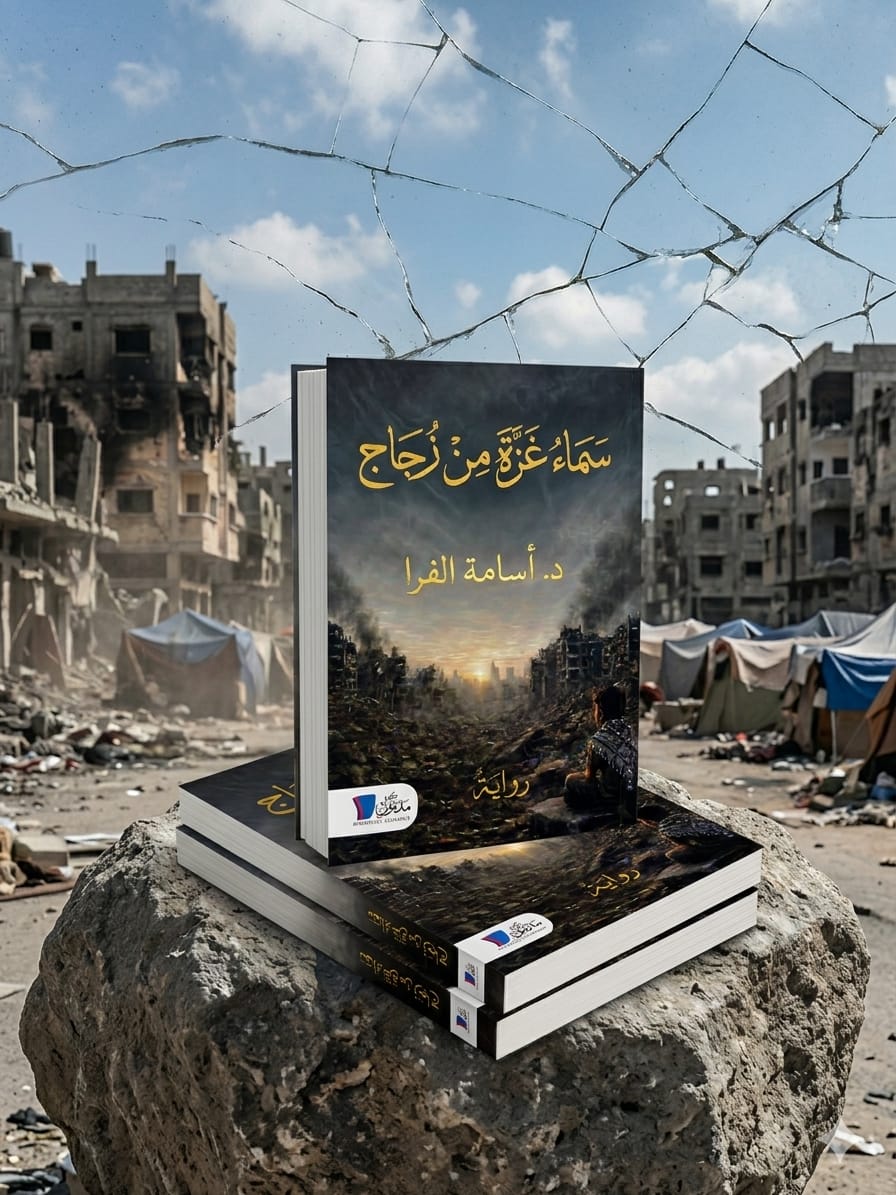
Introduction The novel Sky of Gaza Made of Glass by Dr. Osama Al-Farra was published in 2026 by Madbouly Library in the Arab Republic of Egypt and comprises 416 pages in medium format. Sky of Gaza Made of Glass is a fictional work that reshapes collective Palestinian memory through an imagined individual life, where the story of the Nakba, occupation, and successive wars on Gaza intersects with an internal struggle for identity and the right to live. The novel provides a contemporary reading of the Palestinian cause from a deep human angle, moving beyond direct political rhetoric into spaces of poetic narrative and imagined documentation.
- The Significations of the Novel’s Title The title Sky of Gaza Made of Glass is laden with multiple significations that form a key to understanding the text. In human imagination, the sky connotes elevation, clarity, safety, and protection, but adding “made of glass” turns this implication into its opposite: fragility, susceptibility to breaking, clarity that does not protect. The title combines:
- Gaza as the center of events, a sacred place in Palestinian imagination, a city of resilience and myths, yet a place under siege and bombardment.
- The sky, supposed to be a refuge for the spirit, which in the novel becomes a source of terror (warplanes, rockets) or the field from which cries for help rise from the ground.
- Glass, the transparent material that reveals what is behind it (bare truth), yet is fragile and easily shattered; its shards turn into deadly weapons. The title gains additional meanings through its repetition in the text, especially in scenes where glass shards fly from windows after bombardment, becoming a metaphor for the Palestinian condition: clear sight yet threatened with shattering at any moment. Glass also refers to mirrors— the possibility of seeing the self and truth— but under a war narrated by multiple means, truth becomes broken mirrors reflecting multiple narratives.
- The Narrator and the Focalization The novel relies on an omniscient third-person narrator who leans toward internal focalization (internal viewpoint). The writer uses shifting focalization of the narrator’s self by concentrating intensely on the consciousness of the central character, Haneen, a Palestinian journalist. The narrator almost fuses with her, conveying her emotions, doubts, memories, and psychological disintegration under the pressure of war. This is clear in the opening pages: “She put on the garment of silence since her gaze began to ignore the visible, as if she had suddenly plunged into her depths and closed the door behind her… she walks while inside her another world.” Here the narrative begins from a moment of self-alienation that reflects an internal fracture preceding the fracturing of place. The narrator does not limit itself to external description but delves into the soul, using a condensed poetic language approaching stream-of-consciousness in many passages. Alongside Haneen, the novel allows the narrator to move among other characters: Karim the husband, Oliver the British friend, Amos the Israeli, and family members. This plurality of voices (polyphony) permits multiple viewpoints while maintaining Haneen’s narrative centrality as the organizing principle of perspective.
- Narrative Techniques
- Flashback The novel is built on intensive flashback technique. It begins with a scene of Haneen in London (the narrative present), then moves back through a series of memories: childhood, adolescence, university days amid Palestinian division (2007), her marriage to Karim, her radio work, her dismissal for bold reports, and the births of her children. This flashback structure not only documents the life story but creates a temporal rhythm linking personal past to collective present, showing that the Palestinian struggle is not a sudden event but an accumulation that reproduces itself in individuals’ lives.
- Stream of Consciousness and Interior Monologue In moments of extreme tension, the narration shifts into stream-of-consciousness embodying mental chaos. In bombing and siege scenes, voices, images, and memories intermingle in Haneen’s mind, and the narrative form mirrors the content of trauma. For example, in her description of the Baptist hospital massacre: “How can they reduce catastrophe to numbers, how does the victim become an empty number, how can a number contain the story, and behind each victim a thousand stories and a story.”
- Multiple Focalization The narrator sometimes adopts external focalization (describing scenes from the outside) and sometimes internal focalization through other characters: through Oliver we learn details of the settler attacks around Gaza on October 7, and through Amos we learn Jewish suffering in Poland during the Holocaust; through Boutros (whose story is embedded to serve the scene) we learn paradoxes of identity and naming. This multiplicity creates a dialectical vision that avoids a single center.
- The Imagined Document The novel uses the technique of inserting imagined documents: press reports, letters, recordings (such as the flash drive Oliver gives Haneen). This creates an illusion of verisimilitude and grants the narrative documentary credibility that reinforces the historic dimension of events (Gaza wars of 2014, 2023–2024, Palestinian division, the Al-Aqsa flood).
- Structure — A Structural Analysis A. Surface Structure and External Construction The novel is divided into numbered chapters (1–25) without internal titles, giving an impression of continuity and flow despite nonlinear time. A short poetic text (p.5) precedes chapter one, framing the novel as a tale of resilience. Chapters vary in length, reflecting a shifting rhythm between calm narration and accelerated war scenes. B. Deep Structure: Binary Oppositions A structural analysis reveals a set of binary oppositions that form the deep structure of the text and generate meanings through relations of difference and contrast:
- Memory / Forgetting: This binary is central; characters (Haneen, her grandfather, Amos) fight forgetting by restoring stories, while occupation mechanisms and media seek to erase memory.
- Life / Death: Manifest in bombing and massacre scenes versus scenes of birth (the birth of Ziad) and making bread. Death in the novel is not an end but a transformation into testimony and story.
- Voice / Silence: Haneen, a journalist, produces voice yet dons “the garment of silence” in collapse moments. Silence at times is resistance (“We die standing and will not kneel”) and at times complicity.
- Place / Refugee: Gaza is not merely a place but a living entity, while displacement turns people into beings without place. The homeland/exile binary recurs in Haneen’s grandfather’s story (Hamama) and the family’s southward displacement.
- Truth / Narrative: The novel revolves around competing narratives: Israeli narratives, official faction narratives, Western media narratives, contrasted with the truth Haneen seeks through field documentation.
- Center / Margin: Palestine/Gaza as the center of events, London and Western capitals as margins witnessing; the novel inverts this binary by making Gaza the center of human presence par excellence. C. Recurrent Patterns
- The Sky: Repeats as a multi-signified mark: “Sky of Gaza made of glass” (fragility); the sky is bombed (warplanes); the sky is where prayers and pleas ascend.
- Glass: Symbolizes fragility, transparency, and fracture. Scenes of flying window glass after bombing transform it into a central metaphor for the Palestinian condition.
- Tannour Bread: Repeats as a daily ritual of life and an act of resistance through survival and production of life. Women bake it despite war; it sometimes substitutes for speech.
- Dance and Songs: Songs by Umm Kulthum and Kadim Al-Sahir recur in moments of temporary joy, creating a structural contrast between fleeting life moments and the backdrop of continuous death. D. The Semiotic System of Signs
- Gaza: Not just a place-name, but a complex sign referring to resilience, siege, testimony, life under bombardment, and the dream of return.
- Haneen (the name): A linguistic sign evoking longing and sorrow, condensing the novel’s emotional meaning.
- The Flash Drive (the digital memory): In the scene where Oliver gives Haneen the flash, it becomes a sign of threatened truth and a counter to official narratives.
- The Keffiyeh: A national identity sign worn by multiple figures (the keffiyeh bearer who advised Oliver to visit Palestine) functioning as a cultural resistance mark. E. Structural Relations Among Characters Characters can be viewed by their narrative functions:
- Haneen: The central protagonist combining womanhood, journalism, and motherhood; she mediates between truth and story, private and public spheres.
- Karim: The supporting character representing emotional and familial stability and moderate critical stances.
- Khaled: A double-faced character embodying internal Palestinian conflict and division.
- Oliver: The bridge between cultures, representing the possibility of bearing witness from the Western interior.
- Amos: A mirror figure reflecting the complexity of Jewish memory and expanding the conflict beyond simplistic binaries. F. The Spiral Temporal Structure Time in the novel is non-linear, assuming a spiral shape: it starts with the present (London), returns to distant past (Haneen’s childhood, her grandfather’s Nakba), returns to the present (Gaza war), then moves toward the near future (end of the war, 2025). Each return to the past does not merely repeat but adds a new layer of meaning, creating dramatic and semantic accumulation.
- Deconstructing Symbolic Meanings The novel is rich with central symbols that can be unpacked structurally, where a symbol is read as a linguistic sign with multiple meanings determined by its relations inside the text’s semiotic system:
- The Glass Symbol Glass recurs as a central symbol reflecting fragility and transparency simultaneously. Glass shards fly from windows in bomber scenes, becoming a metaphor for Palestinian internal and external fragmentation. Glass also evokes the mirror of the self allowing view of bare truth; yet that vision becomes painful when it reveals the catastrophe’s magnitude. In the title, the sky itself becomes glass— the final refuge of the spirit is as breakable as the earth.
- The Window Symbol Windows recur: the hotel window in London from which Haneen sees a foggy city, and home windows in Gaza that explode with flying glass. The window loses its traditional function (viewing and ventilation) and becomes a fragile boundary between inside and outside, safety and danger, life and death.
- The Bread Symbol Tannour bread appears in multiple scenes, notably at the rural house in Al-Qarara where women bake and distribute bread to displaced people. Bread here is not merely food but a symbol of life and survival— a daily act of resistance through continued production of life amidst death. Bread also becomes a ritual of women’s communication and a silent language of love and giving.
- The Tree Symbol (the Olive Tree) A colossal olive tree in the village of Al-Wajla (Mother of the Olive) stands as a symbol of resilience, identity, and roots. Abu Isa recounts its story: it is five thousand years old, older than the revealed religions. The tree symbolizes Palestinian temporal continuity preceding occupation and cultural resistance through persistence despite attempts to uproot it.
- The Dance and Song Symbol The novel is interspersed with dance and song scenes: Ziad’s birthday, family celebrations. These scenes create a structural contrast with death scenes, turning dance and song into acts of existence affirming life. Umm Kulthum’s song “Tomorrow I Will Meet You” (given by Kamal to Fadwa) and Kadim Al-Sahir’s song (sent by Karim to Haneen) turn into symbols of love that endures despite war.
- The Flash Drive Symbol (Digital Memory) Oliver gives Haneen a flash drive containing footage of what happened at Kibbutz Be’eri on October 7, outside the Israeli official narrative. The flash symbolizes alternative truth and the possibility of resisting erasure through technology, but it is also a symbol of truth’s fragility— stored on a small, easily lost or destroyed device.
- The Name Symbol (Boutros) The story of Boutros, who had to change his name after being accused of spying because of his Christian name, encapsulates the paradox of Palestinian identity. A name becomes a sign of danger and a symbol of internal identity struggle. The story also points to the arbitrariness and oppression of security apparatuses.
- The Clock Symbol (Stopped Hands) Scenes of clocks that do not move in moments of waiting and fear, especially in the displaced family’s house in Al-Qarara, symbolize war’s suspended time, life held between bombardment and bombardment, and losing control of time to the machine of death.
- The Cart and Horse (Displacement) The family’s displacement on a cart pulled by a horse driven by a boy who has not yet left childhood turns recurring Palestinian displacement into an enduring myth repeated across generations. The horse and cart symbolize primitive displacement that reproduces the 1948 Nakba in the present.
- The Maimed Corpse Symbol Repeated images of torn corpses, especially in the Baptist hospital and Jabalia massacres, become symbols of an unrepresentable catastrophe and silent indictment of a world that watches. The corpse is the novel’s counter-image to media portrayals— a bodily truth that cannot be denied.
- Idea and Themes
- The Palestinian Cause: Nakba, Refugeehood, and Return The novel establishes its Palestinian identity through inherited Nakba memory. Haneen’s grandfather (Abu Kamal), who was displaced from the village Hamama, lives with the dream of return until his death. The novel creates a chain of correspondences: the Nakba of 1948, the 1967 setback, and successive Gaza wars. It does not present return as romanticized, but as an inherited pain: “The fathers’ pain does not die; they sprinkle it on their children as they inherit facial features, it only takes a new shape with each generation.”
- Resistance and Resilience Between Myth and Reality The novel reads resistance as a multi-dimensional concept: armed resistance, resistance through word and media (Haneen), and everyday resilience (women making bread and running life). It criticizes internal extremism via campus fighting scenes (2007), arbitrary arrests, and politicized takfir discourse. Khaled embodies engagement in domestic violence, while Haneen and Karim represent a critical middle ground.
- Media and Truth Journalism is central: Haneen works for the BBC, is fired for her bold reports, then returns to document Gaza’s war. The novel interrogates Western media neutrality and bias toward Israel through scenes like the London workshop and Amos’s critique of coverage of Muhammad Abu Khdeir’s killing.
- Women and Emancipation Haneen is a model of a Palestinian woman facing compounded challenges: patriarchal society (her choice to study media against her father’s wishes), familial pressures (relationship with Khaled), and war (as a journalist documenting death). The novel celebrates her voice, culture, and courage, showing how women become guardians of memory and identity, particularly through Fadwa (the mother) who passes on stories and songs.
- Extremism and the Other The novel presents Amos, the Israeli character, as a complex other. Through his dialogues with Haneen and Oliver, the writer shows the possibility of transcending stereotypes without eliminating the core of the conflict. Amos recounts his grandfather’s resistance to Nazism in Warsaw and subsequent migration to Palestine. The novel does not use this memory to justify settlement but frames it as another tragic memory urging reflection on justice rather than revenge.
- War and Daily Death War in the novel is not a background event but a living entity consuming small details: tannour bread, children’s toys, the displacement bag, the mother’s kiss. Bombing and massacre scenes (the Baptist hospital, Jabalia) are depicted with documentary realism yet transcend to a poeticness of tragedy that exposes language’s inadequacy to encompass the catastrophe’s true scale.
- Dynamics (Dramatic Movement) Character Development
- Haneen: Moves from an optimistic student to a critical journalist, then to a woman balancing motherhood and professional work, and finally to a displaced person who has lost much. Her development is spiral rather than linear; each return of war adds a new layer of experience and pain.
- Karim: The supportive husband who does not seize the stage but provides moral and material support. His development shows his ability to balance between resistance (as a former activist) and humanitarian work (helping displaced persons).
- Khaled: Haneen’s brother moves from an enthusiastic youth in a faction to a withdrawn person after fighting, then disappears into detention and war. He represents the internal victim of division.
- Oliver: The British journalist shifts from external observer to partner in documentation to bearer of an alternative narrative about October 7 (through his report on Kibbutz Be’eri). The novel contains multiple conflict levels:
- External conflict: Palestinian–Israeli (wars, bombing, occupation).
- Internal conflict: Palestinian–Palestinian (division, fighting).
- Existential conflict: the individual confronting death, fear, and life under bombardment.
- Epistemic conflict: the search for truth amid competing narratives. Two principal climaxes are identifiable:
- The first: scenes of the Baptist hospital massacre (chapter 9), where Haneen nears psychological collapse.
- The second: scenes of the Jabalia massacre (chapters 11–12), representing apex destruction and absurdity. After these peaks, the narrative shifts to temporary calm and the family’s displacement southward, in a movement of rise and fall mirroring the state of war. The pacing alternates between reflective slowness (mental and descriptive passages) and accelerating speed (bombing and massacre scenes), creating suspense and tension that immerse the reader in wartime temporal experience.
- Language and Style
- Poetic Language The novel uses condensed poetic language rich in metaphors and images. This appears in psychological description: “She left her thoughts that night to emerge from the chrysalis of silent pain.” And in place description: “The city appeared to her soulless, its old buildings wailing their past, its streets begging for life.”
- Condensation and Repetition The novel uses repetition to create a rhythm reflecting the whirl of war and pain. For example, the phrase “Sky of Gaza made of glass” recurs in various places, transforming it into a symbol of fragility before bombardment.
- Dialogue Dialogues are not mere speech transmission but carry ideological dimensions; Haneen’s conversations with Amos, Oliver, and colleagues turn into a field for testing ideas and deconstructing discourses.
- Intertextuality The novel refers to texts, songs, and autobiographies: · Songs by Umm Kulthum (“Tomorrow I Will Meet You”). · Songs by Kadim Al-Sahir. · Ghassan Kanafani’s Return to Haifa. · Personal histories like Wael Zwait’s (the Palestinian activist assassinated by Israel). · Historical events such as the Battle of Karameh and the Warsaw Ghetto uprising. These references weave a web of meanings enriching the text and linking it to broader cultural and struggle memory.
Conclusion: A Critical Summary Sky of Gaza Made of Glass is a novel that aims to document the Palestinian moment in a language that merges harsh realism with dense poetry. It reconstructs modern Gaza history through an imagined individual story yet succeeds in transforming that tale into a collective narrative that captures Palestinian reality’s contradictions: internal division, ongoing resistance, life under bombardment, the media’s role, women’s role, and the persistent search for justice horizons. Technically, the novel employs modern narrative techniques: multiple voices, stream-of-consciousness, flashback, and shifting focalization. Its non-linear temporal structure mirrors memory fragmentation and the intertwining of times in collective Palestinian consciousness. The language balances documentary precision with poetic detours, enabling representation of what is often unrepresentable: the humanitarian catastrophe’s scale in Gaza. From a structuralist perspective, the text reveals a deep structure built on binary oppositions (memory/forgetting, life/death, voice/silence, place/refugee, truth/narrative) that drive meaning, alongside recurrent patterns (the sky, glass, tannour bread, dance) that give organic cohesion, and a semiotic system where names and objects become signs loaded with compound meanings. Structural relations among characters appear as integrated narrative functions, and the spiral temporality functions generatively for meaning. Deconstructing the symbols shows that the novel constructs a coherent symbolic world in which ordinary objects (glass, window, bread, tree, flash drive, name) become carriers of meanings that transcend their immediate sense to speak of fragility, resilience, identity, memory, and truth. These symbols operate not in isolation but in a network of mutual relations that reinforce one another and create an integrated system of signification. However, the novel can be critiqued for occasional descriptive density, especially in repeatedly graphic bombardment scenes that may exhaust the reader, and for its heavy focus on Haneen at the expense of deeper development of some secondary characters. These criticisms do not diminish its value as an important literary work embodying contemporary resistance literature; it writes Gaza in a language that faces death with life, fragmentation with memory, and defeat with resilience. The novel does not present Gaza as a mere place but as an ongoing, unforgettable tale, as stated in its poetic dedication. It is an epic novel documenting daily events Palestinians in Gaza face repeatedly—topics rarely addressed in Palestinian novels during the genocidal war; even where novelists have written on the subject, this work illuminates pains that may be forgotten or overlooked. Therefore, Sky of Gaza Made of Glass is a significant addition to Palestinian literary holdings.