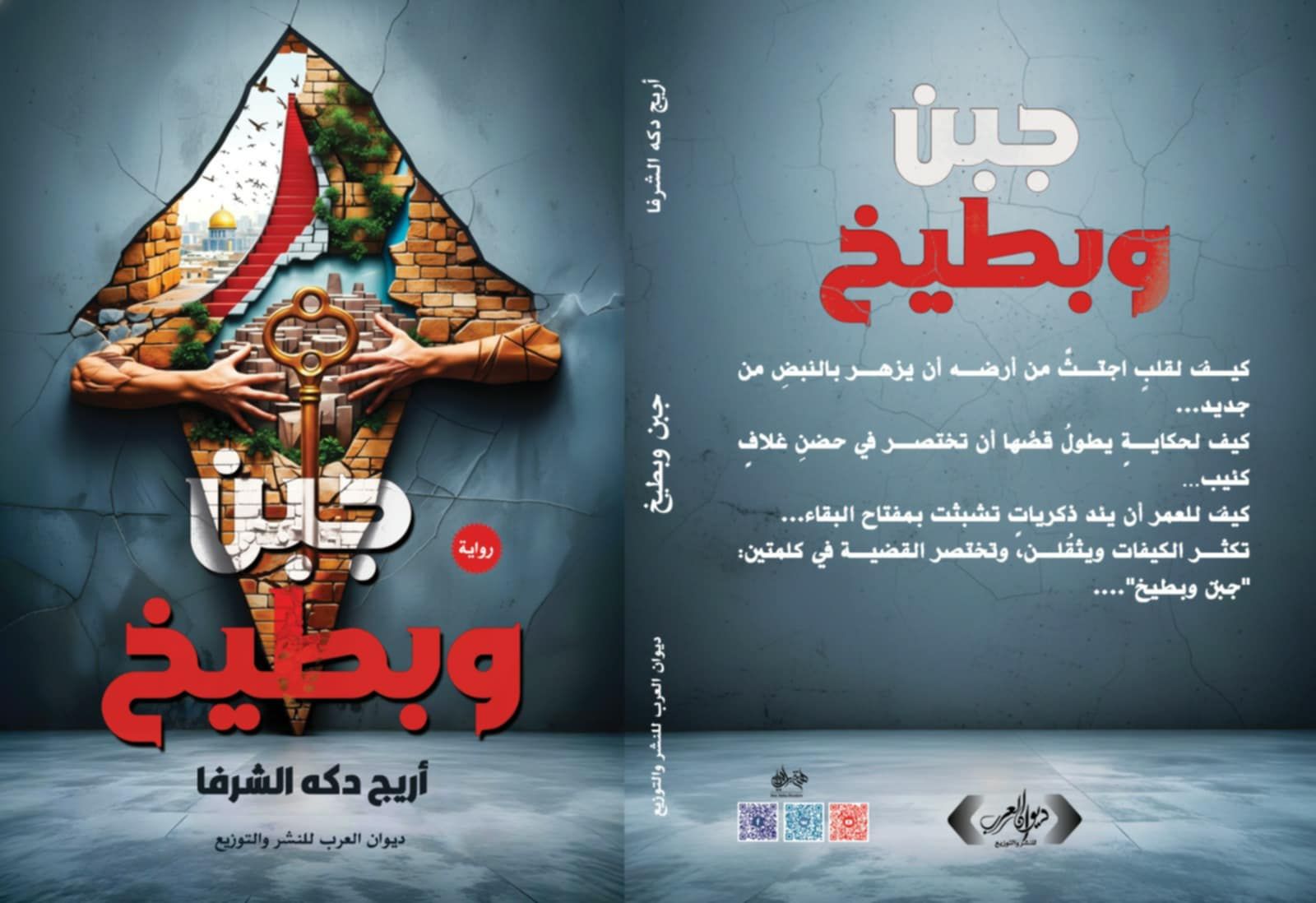
By Author: Areej Dakkah Al-Shurafa
Published by: Diwan Al-Arab for Publishing and Distribution, 2026
Format: 250 pages (medium octavo), divided into 14 chapters.
General Synopsis
The novel “Cheese and Watermelon” offers a condensed and intense narrative that reflects the Palestinian reality under occupation and conflict through two parallel timelines: the past (1944 and its aftermath) and the present (2023 during the war on Gaza). The lives of the characters intertwine between Burqa, Gaza, and Isdud, painting a complex human tapestry that blends daily tragedy with resilience, historical memory, and identity.
Technical and Literary Aspects
- Narrative Structure and Framework
- Parallel Narrative: The author successfully weaves two overlapping timelines with great skill, creating a dialogue between the past and the present, which deepens the sense of historical continuity of the tragedy.
- Numbered Chapters with Symbolic Titles: Each chapter begins with a maxim or an observation about mice, turning the mouse into a recurring motif and symbol (representing the occupation, fear, and infiltration).
- Polyphony (Multi-voiced Narrative): The author employs a multi-voiced narrative technique, providing the reader with a comprehensive view from multiple perspectives (Ahed, Saleh, Jinan, and others).
- Characterization and Dramatic Development
- Rich, Multi-dimensional Characters: Such as Ahed (the steadfast mother), Saleh (the bearer of the land and family worries), and Jinan (the infertile woman facing social pressures).
- Meticulous Detail: The author provides each character with a psychological and social background that justifies their behavior and development.
- Complex Human Relations: Exploring the extended family, neighborly ties, friendship, and internal conflicts within the Palestinian society itself.
- Language and Style
- Realistic Poetic Language: Characterized by long verbal sentences, rich sensory descriptions, and vivid scenes that convey scents, sounds, and emotions.
- Palestinian Linguistic Heritage: The use of proverbs and local idioms (such as Taboon, Bayyara, Al-Mares), which enriches the text and roots it firmly in its environment.
- Balance Between Narration and Dialogue: The dialogues flow naturally, revealing the characters’ inner conflicts and personalities.
- Symbolism and Semiotic Layers
- The Mouse as a Central Symbol: It represents the infiltrating occupation, internal dread, the hidden threat, and the ability to multiply and endure despite harsh conditions.
- Food as a Symbol of Identity and Resistance: Cheese and watermelon (the title), Shakshouka, Fattet Al-Ajar, Falafel… all of which are dishes deeply linked to heritage and survival.
- Land and Honor (Al-Ard wa Al-Ard): The conflict between preserving the land and safeguarding honor (women’s dignity) in the face of both the occupier and society.
- Major Themes
- Resilience Against the Occupation: Portraying the daily realities of war, displacement, fear, and the stubborn cling to life.
- The Palestinian Woman: Her strength, endurance, patience, and pivotal role in preserving the family and identity.
- Memory and History: Linking the 1948 Nakba to today’s wars, framing it as a continuous, ongoing tragedy.
- Internal Conflict: Delving into issues within Palestinian society (such as collaboration with the occupier, family disputes, and societal pressures of traditions).
Author’s Proficiencies and Strengths
Areej Dakkah Al-Shurafa has presented a contemporary Palestinian novel distinguished by several strengths that highlight her mastery of the craft:
- Boldness and Depth: The author tackles highly sensitive and complex issues directly and without oversimplification, while maintaining a holistic, humanistic perspective.
- Research and Verification: The novel demonstrates precise historical and geographical research (toponyms, agricultural details, social customs), lending the work authenticity and richness.
- Integrated Artistic Vision: She successfully integrates political, social, and psychological elements into a cohesive narrative fabric, without letting one aspect overshadow the other.
- Humanitarian Commitment: The author does not offer hollow political slogans; instead, she penetrates into the depth of the Palestinian human experience with all its contradictions and hopes.
- Narrative Innovation: The non-linear structure, recurring symbols, and the intersection of the two timelines are all techniques that enrich the text, elevating it into a sophisticated literary work.
Narrational Challenges Overcome by the Author
Undoubtedly, the author faced several creative challenges, which manifested in:
- The density of details and multiplicity of scenes could have overwhelmed the writer in maintaining the required focus to preserve the novel’s dramatic line. However, the author successfully managed and controlled this multiplicity.
- The multi-branched timeline required extreme precision to connect the threads of characters and eras. Here too, the author maintained a firm grip without letting the narrative slip away.
- Certain events and scenes demanded a high emotional tone that verged on passionate fervor. The author maintained balance, granting each situation its deserved vocabulary and linguistic arrangement without exaggeration.
Conclusion
“Cheese and Watermelon” is a mature and significant novel that delivers committed literature without compromising the aesthetics of the novelistic art. Areej Dakkah Al-Shurafa is a writer who commands her tools with confidence, delivering a novel that will leave a lasting mark on contemporary Palestinian literature.
This work is not merely a testimony to a time of war; rather, it is a profound exploration of the Palestinian soul in the face of existential threats—an artistic achievement that beautifully marries human honesty with literary brilliance. It is a novel highly deserving of reading and study, establishing its author as one of the vital upcoming voices in the Arabic literary scene.