My window overlooks a “postponed beginning”
Dr. Khaled Turki
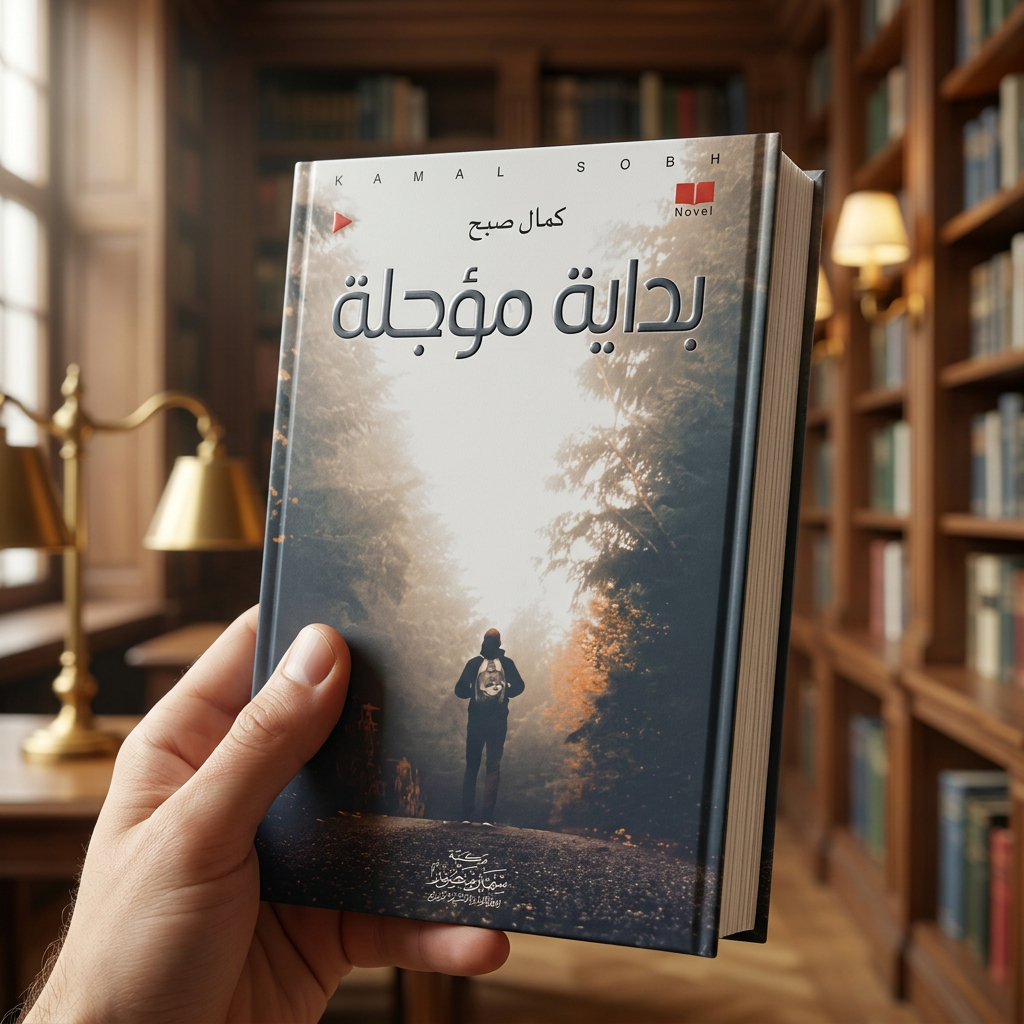
“A Deferred Beginning” is a novel by the Gazan writer Kamal Subh, which tells us about the life of the Palestinian over a long period of about one hundred years, when my country was suffering under different occupations, and my people did not enjoy a single moment of freedom, independence, peace, or tranquility. This included the tyrannical and obscurantist Ottoman rule, the unjust and conspiratorial British occupation that continues to this day, the Jordanian and Egyptian rule under the “relatives” and those closest to the enemy, the unholy trinity, rather than to my people, and the Israeli rule that has held my people in its yoke since the last century until today. The events of the novel take place between Jerusalem, the Flower of Cities, the courtyard of the Noble Sanctuary, the Cotton Market, Iraq, Jordan during the Black September massacres, Damascus, and Lebanon in Tel al-Zaatar. The Tripartite Aggression against Egypt, the immortal leader Gamal Abdel Nasser, and the friendly Soviets who supported and stood by the Egyptian people to repel the aggression, and it tells us about life between resisting the oppressive occupier and confronting the collaborators of the occupation from among our own people, and the process of supporting and assisting the Palestinian people with its warm embrace and nurturing environment, and the sacrifice and martyrdom of the revolutionaries for the sake of the homeland’s pride, dignity, and honor…
For the flame of struggle and resistance has not been extinguished and will not be extinguished, “as long as I have a span of my land”…
Every beginning has an end, but for the beginning to be postponed means that the beginning has not yet come, or that its conditions have not yet begun, and therefore it was postponed, after the novel ended with the suicide of one of its heroes, Mahmoud Ibn Al-Hajj Maarouf, when he said before His suicide, to Maria: “Don’t you know how defeats happen? They’re a collection of small defeats that we pile up to become one big defeat. I defeated myself long ago. The defeat was inside me, but it was a delayed beginning. He grabbed the pistol… closed his eyes. A faint noise, the sound of the bullet hitting the wall after it had carried half his head along its path” (p. 254). He closed his eyes at the moment of his suicide because he didn’t want to see himself dead, nor did he want to die for himself. He wanted a martyr’s death, but he went ahead with this act after finding himself a plaything in Maria’s hands. She had lured him and her agent, his friend Awni, to her bed. (With friends like these, you don’t need enemies, or at least make sure of the kind of friends you have before befriending them.) She was working for militias. Armed, in Lebanon.
He couldn’t bring himself to betray his cause, so he found in suicide an escape from his predicament with her and her party, and a way to protect his comrades and their names, after they had asked him to betray his comrades, revealing their addresses and jobs so they could be eliminated. “…You will have a list of the names of the soldiers and officers working in the camp. Don’t you work there in the administration?” (p. 242).
When Mahmoud was a child, a student in school, he was the revolution’s messenger between his father, Haj Maarouf, and the other revolutionaries, who awaited his instructions and guidance. “…The revolution’s messenger between you and the overseer” (p. 60).
I don’t know why he chose this end for himself, or why the writer Kamal Subh chose this suicide death for him. He could have taken revenge, followed the path of the fedayeen Sarhan al-Ali from Arab al-Saqr, as described in the poem “Sarhan and the Pipeline” by the poet and freedom fighter Tawfiq Zayyad, when he blew up an oil pipeline:
“It carries the good that springs from the land of the Arab peoples to foreign lands. Ah, Sarhan, if only… if only… it would explode!” (Diwan Amman in September, p. 77). Sarhan al-Ali from Arab al-Saqr was martyred shortly after the oil pipeline explosion. Sarhan’s end was heroic and self-sacrificing; his martyrdom was more beautiful than Mahmoud’s suicide, even though death is the same. The difference is that to die honorably, bravely, defending, and rebelliously is different from to die fleeing. Fleeing and retreating, you will humiliate your enemy…
“Either a life that pleases the friend or a death that enrages the enemy.”
How I wished that Mahmoud would die the death of his father and grandfather, a martyr, enraging the enemy, as Haj Maarouf used to say, “I will remain where I am” (p. 35).
In the novel, this dialogue with Maria appears (p. 239), when Mahmoud asks her:
-Are you a Christian?
-Yes, I am a Christian. My name is Maria, and I work as a domestic servant.
I believe this dialogue was superfluous, unnecessary, and irrelevant to the narrative of the national cause. A revolutionary like Mahmoud wouldn’t ask such questions. It would have been more appropriate, within the context of the story, to ask her about her political affiliation—whether with the Kataeb or the Lebanese Forces, for example. It was unnecessary to insert her sectarian affiliation into the narrative, as it only reinforces the division and fragmentation of our people. Religious affiliation, in this context, forces you into the corner of political affiliation, and this is a grave mistake.
“…No religion divides us.”
“…Neither the antiquated weapons we possessed nor the meager armies that rushed to our aid could save us. Palestine fell, Gaza under Egyptian tutelage, and we remain under Jordanian tutelage…They will continue their advance until…” They will confiscate what remains; it’s only a matter of time. (p. 23)
As for Haj Maarouf, he is known to be one of the notables and nobles of Jerusalem, a renowned merchant, indeed one of its leading merchants, a martyr, the son of a martyr. Haj Maarouf’s father was a fighter, “…a support to all who sought his protection, a martyr before he was killed by the bullet of that hateful Englishman, and a martyr he became” (p. 31). Haj Maarouf is one of the martyrs of the June War, the setback of Palestine, in 1967, and not the Six-Day War as stated in the book, because that term is a boastful and arrogant Zionist term they use to flaunt their heroism and victory over three Arab countries with the numbers and equipment of “…the exhausted armies…” (p. 21), in just six days. Haj Maarouf is a patriotic man, fiercely protective of his country and homeland. A member of the Palestinian National Council (p. 43)