“Ivanov in Israel”: Intersecting Fates Between the Loss of Jaffa and the Rebirth of Memory
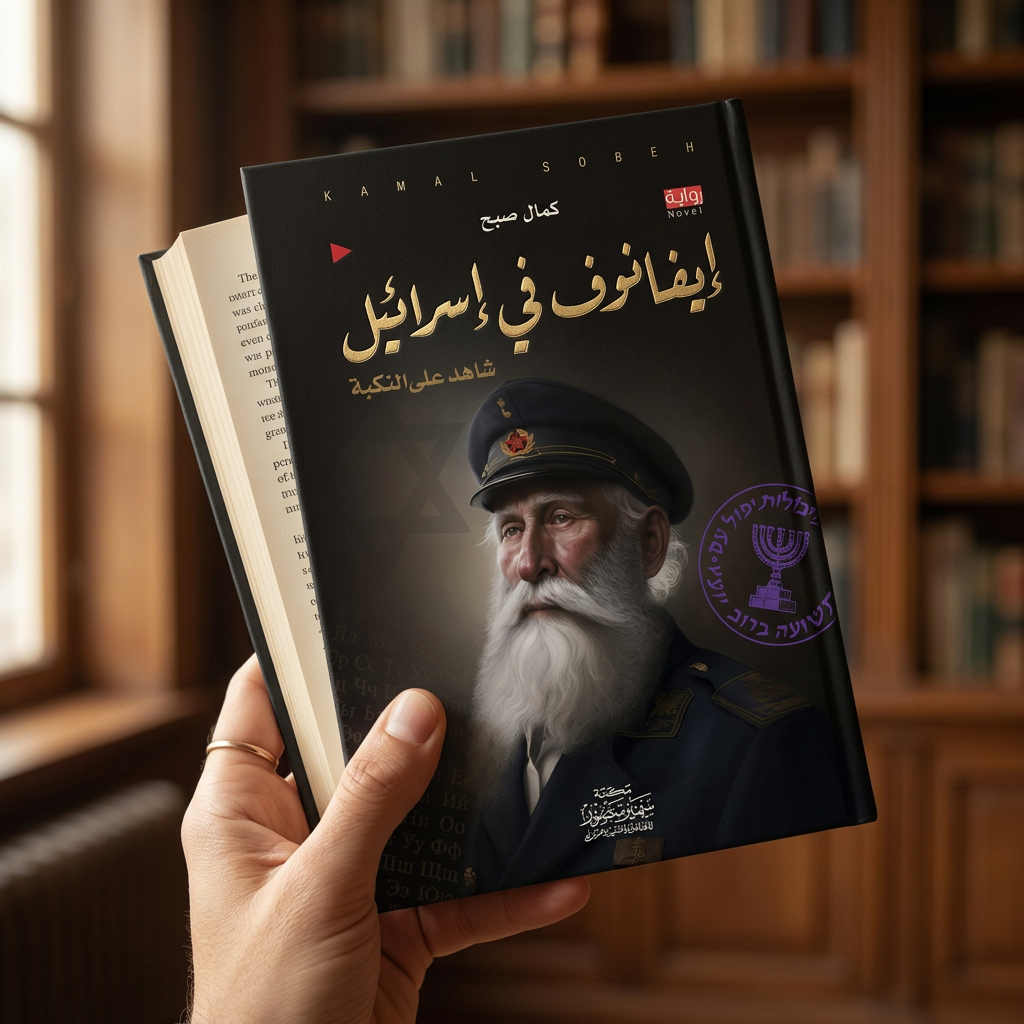
In his novel Ivanov in Israel, Kamal Sobeh presents a distinctive narrative that utilizes “documentation” and living memory as its stage. The novel is not merely a recollection of the 1948 Nakba; rather, it is a profound narrative trial that examines how the history of the defeated is erased and rewritten in “white ink,” as the work’s opening epigraph suggests.
The novel centers on the character of “Ivanov,” who finds himself a witness to seismic shifts in the city of Jaffa, its port, and its neighborhoods, where personal stories intersect with national catastrophe. The work highlights resistance plans and the attempts to preserve identity in the face of the machinery of erasure and displacement. The narrative blends warm human moments—such as the children’s meeting at Clock Tower Square—with the brutality of a historical moment that scattered families between Jaffa, Cyprus, and beyond.
The author masterfully portrays Jaffa not just as a geographical city, but as a living entity being stripped of its existence. Existence here is “written in white ink,” a metaphor for the victor’s attempts to obliterate the landmarks and history of the land. Letters and memoirs emerge as tools of resistance, where names are inscribed “between skin and bone” to ensure they are never forgotten. It is a novel about historical integrity and the search for truth amidst the rubble of fabricated narratives.
Ivanov in Israel is a qualitative addition to Nakba literature, moving away from overt political messaging to provide a psychological and social autopsy of a pivotal era. With sophisticated language and a high capacity for cinematic scene-building, Kamal Sobeh transports us into the heart of the suffering, asserting that no matter how much history is written with the ink of falsehood, the blood of the victims and the memory of the survivors remain the only indelible ink